
Gill - Making a Short Film - pt. I

I’ve shot a few short docs, like 41x and Mr. Gold, but I had a hankering to direct a narrative. Having complete control of a story, directing a crew and actors, and seeing a major project through to completion really enticed me. I had fallen in love with movies as a kid, so why not make what you love? Plus, I was feeling a little bored with my current body of work.
Now I know jack-diddly-squat about writing a screenplay. And I’m smart enough to know I shouldn’t try (at least not now). But the world is big and the internet seems bigger, so I figured there must be some website where writers go to share their work. Luckily I found one and dove in head first. I read…a lot. I honestly had no idea what I was looking for. But after taking in 100+ scripts I found out I wanted to direct a film with a concrete ending (not a character study or a vignette of a story). I also figured whatever I liked would jump out at me, make me excited, and cause my heart to flutter. That proved true. Eventually I came upon Alexandra Keister’s work. She largely writes comedies with heart (but I wouldn’t dare box her into that category). But after rereading a particular script of her I found an issue…the film would be outside my budget (sweat and $0) and it couldn’t be rewritten to accommodate that.
So I reached out, told her I loved her work, and asked if she had anything else I could read. She sent me another piece that was perfect (you can read the original here). It had 1 location, 2 actors, very little special effects, some dark comedy elements, a lot of heart and depth (not easy for a short), and most importantly it made my heat skip a beat. There’s nothing like getting excited about something you can immediately visualize.
Alexandra was gracious enough to trust me with it. I began by doing A LOT of analysis, an example of which is below (Richard Gretsky was invaluable in this). I dove into each characters backstory, their motivation, their wardrobe, the look and feel of the location (props to Thomas Hayek, my production designer, for helping with this), the way we would capture it (DP Erik Van Lenten was instrumental here), and how we would pull it off (James Rayner did an amazing job at producing). My advice for new filmmakers regarding script analysis: do it until you can’t stand it—then do it more. I won’t go into too many details but suffice it to say it was dizzying and gave me insight into why so many people are involved in films.
Part of my analysis was creating a storyboard (below). And since I’m a visual thinker (as are most directors), doing this was incredibly helpful. Unfortunately I’m horrible at drawing so I relied on storyboarding software. What’s funny is I barely stuck to any of the drawings when making the film. Either the location wouldn’t allow it or a better idea popped up. But doing this allowed me to understand the story in a more granular way, helped me think through how I would transition between scenes and locations, how I’d edit, and it showed those involved that I was serious about the film and was giving it my all. And that’s critical because I was asking them to pitch in their time; I wanted them to give it the same dedication.
Be sure to check out how the shoot went down in pt. II of this series.
An example of the script analysis for Gill.
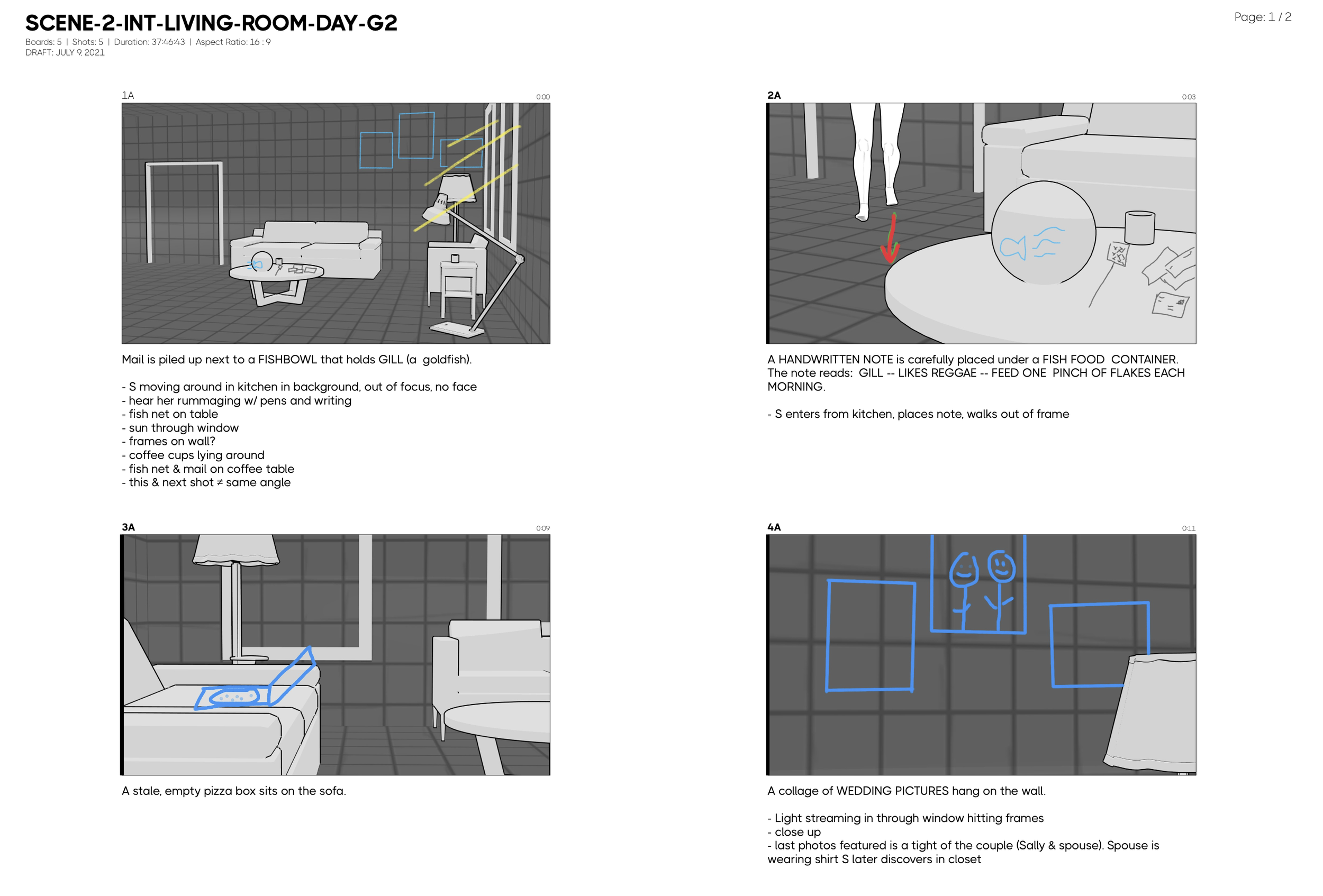
The storyboard…don’t laugh. Click to see the whole thing.